
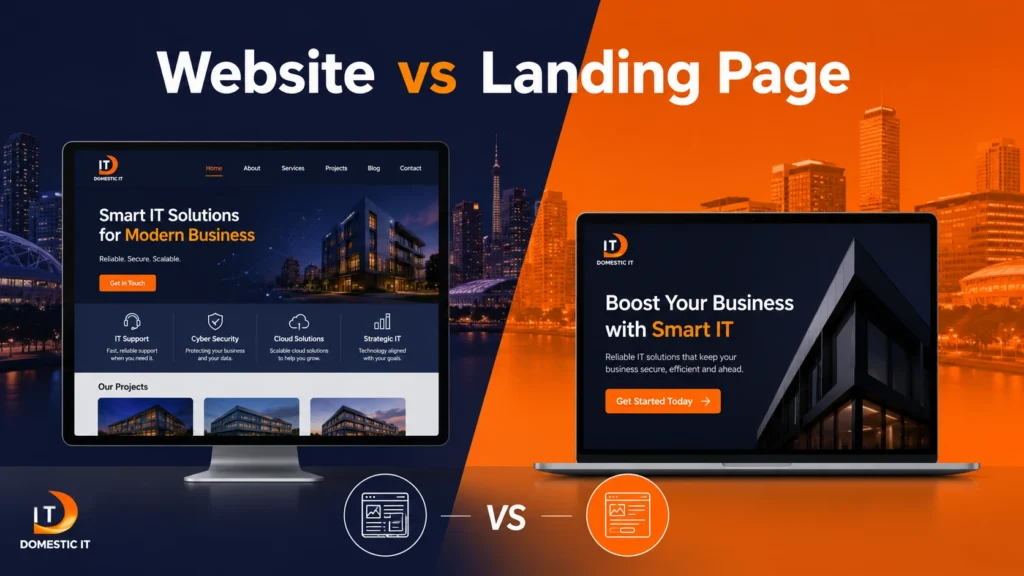
Choosing between Website Design vs Landing Page is really a question about what you need visitors to do. A full website gives your Adelaide business a permanent online home where people can discover your services, learn about your company and build trust over time. A landing page has a narrower purpose: it takes a specific visitor from a campaign or offer and guides them towards one action. Neither option is automatically better. The right choice depends on how customers are finding you and what you want to happen after they arrive.
A useful way to think about the difference is this:
| Full Website | Landing Page |
|---|---|
| Supports the whole business | Supports one campaign or offer |
| Usually has multiple pages | Usually one focused page |
| Built for ongoing discovery | Built for immediate action |
| Supports organic SEO | Often supports paid advertising |
| Multiple customer journeys | One primary conversion journey |
| Long-term digital asset | Campaign-specific marketing asset |
For many established businesses, the answer is eventually both. The important part is knowing which one should come first.
When Your Business Needs a Full Website
A full business website is usually the stronger choice when customers need to understand more than one aspect of your company before making a decision.
It gives you room to explain different services, showcase previous work, answer questions and create pages around the searches your customers make.
Domestic IT’s website design services in Adelaide are built around this broader role: creating a permanent digital presence that supports branding, search visibility and customer enquiries.
Brand Hub
Your website acts as the central source of information about your business.
Customers can use it to understand:
- Who you are
- What you provide
- Who you work with
- Where you operate
- What makes your business different
- How to contact you
- What previous customers say
- What projects you have completed
This matters because people may encounter your company in different places first.
One person may discover you through Google. Another may see your business on Facebook. Someone else may receive your name from a friend.
The website gives all of those people one controlled place to verify the business and learn more.
Unlike individual campaign pages, a full website can communicate the wider brand story. Your About page, service pages, portfolio, testimonials and blog all contribute to that picture.
For businesses offering multiple services, a structured business website design can separate those services clearly instead of forcing every customer through one generic page.
Organic Search
A full website provides more opportunities to appear for different Google searches because separate pages can address different customer needs.
For example, a digital business could have individual pages for:
- Website design
- Ecommerce development
- Landing pages
- Website maintenance
- Custom development
- Website redesign
Blog articles can then support those service pages with informational searches.
Google recommends creating helpful, people-first content and using clear links so search engines can discover and understand related pages. You can review Google Search Essentials for its current guidance.
This is one of the biggest differences in the Website Design vs Landing Page decision.
A landing page can sometimes appear organically, but it is usually not the best structure for covering the full search demand around a growing business.
A website creates room for topical depth.
Deep Exploration
Some customers need more information before they are ready to contact you.
Imagine somebody considering a substantial website project.
They might want to review:
- Your main service
- Previous projects
- Your design process
- Frequently asked questions
- The industries you work with
- Your company background
- Your contact details
Trying to place all of this into one campaign landing page can make the page unnecessarily heavy.
A full website allows people to explore according to their own concerns.
This is especially useful for professional services, B2B businesses, construction companies, healthcare providers and other businesses where the customer may spend significant time comparing providers.
If your website requires calculators, portals, integrations or specialised workflows, custom website development may also make more sense than trying to force complex functionality into a campaign page.
Long-Term Trust
Trust often develops across several interactions.
A visitor may read one blog post today, return to your service page next week and review your portfolio before contacting you later.
A full website supports this longer journey.
Trust-building sections can include:
- Real customer reviews
- Team information
- Case studies
- Before-and-after work
- Certifications
- Detailed FAQs
- Project galleries
- Helpful articles
- Clear business information
Your website also gives you a destination for future SEO, email marketing, social content, referral traffic and offline promotions.
This makes it more than a one-campaign asset.
Domestic IT’s article on how a website helps Adelaide businesses generate more customers explains this broader customer journey in more detail.
When Your Business Needs a Landing Page
A landing page becomes more useful when the visitor already has a specific reason for arriving.
Instead of helping someone explore your entire company, the page focuses on moving them from interest to action.
Adelaide agencies offering landing-page services commonly position these pages around PPC, social advertising and conversion-focused campaigns rather than broad business navigation.
Paid Advertising
Landing pages are particularly useful for Google Ads, Meta Ads, LinkedIn campaigns and other paid traffic.
The reason is relevance.
Suppose your advertisement says:
Need a New Website for Your Adelaide Business? Request a Free Consultation.
The destination page should continue that exact conversation.
It should not send the visitor to a homepage where they must choose between website design, SEO, ecommerce, maintenance and five other services.
Google advises advertisers to use landing pages that closely match their advertisements and keywords because landing-page relevance and usefulness form part of the Google Ads landing-page experience. Read the official Google Ads landing-page guidance.
Domestic IT’s landing page design service is therefore a better internal destination for visitors specifically interested in campaign-focused pages.
Single Offer
Landing pages perform best when the offer is specific.
Examples include:
- Free website consultation
- Website redesign audit
- Seasonal promotion
- New product launch
- Ebook download
- Webinar registration
- Limited service package
- Appointment booking
The page can then remove unnecessary navigation and give the offer enough space to be understood.
Visitors should quickly see:
What is being offered?
Why should I care?
Can I trust this business?
What do I need to do next?
This makes a landing page different from a normal service page.
A service page may support discovery and comparison. A landing page is usually built around one conversion event.
Lead Generation
Landing pages are useful when lead generation is the main objective.
The conversion could be:
- A form submission
- Phone call
- Quote request
- Consultation booking
- Demo request
- Email signup
Because the page has one main goal, it becomes easier to measure whether the campaign is working.
You can compare:
- Number of visitors
- Form completions
- Calls
- Conversion rate
- Lead quality
- Cost per lead
- Performance by device
- Performance by traffic source
This helps separate an advertising problem from a page problem.
For example, a campaign may produce plenty of relevant clicks but very few enquiries. That suggests the landing-page offer, trust signals, form or user experience deserves closer attention.
Our guide to landing page design in Adelaide explains how message match, calls to action and campaign structure work together.
Fast Testing
Another advantage of a landing page is speed of experimentation.
You can create variations around:
- Headlines
- Hero sections
- Offers
- Calls to action
- Testimonials
- Form length
- Images
- Section order
Because the page has one main objective, test results can be easier to interpret.
A complete website redesign is usually a poor way to test whether changing one headline improves enquiries.
A landing page provides a more controlled environment.
However, testing should be based on meaningful traffic and customer behaviour rather than changing elements simply because someone prefers another colour.
The Middle Ground: When Businesses Need Both
For many Adelaide businesses, the real answer is not website or landing page.
It is website and landing page.
The full website establishes the business.
Landing pages support individual campaigns.
For example, imagine an Adelaide building company.
Its main website might include:
- Home
- About
- New Homes
- Extensions
- Renovations
- Projects
- Blog
- Contact
The company then runs Google Ads for:
Home Extensions Adelaide
Instead of sending paid visitors to the homepage, it creates a focused home-extension landing page.
The visitor can still verify the wider business if necessary, but the campaign page keeps the immediate journey focused.
This structure works particularly well when you have ongoing organic SEO and also invest in paid acquisition.
The website answers:
Who is this company and what can they do?
The landing page answers:
Why should I take this particular action right now?
The Design Approach Is Different Too
A landing page and business website should not simply use the same layout with different amounts of text.
Their jobs are different, so their structures should be different.
Website Design Encourages Exploration
A full website normally uses broader navigation because visitors arrive with different intentions.
Someone may want to:
- Learn about the company
- Research a service
- Browse projects
- Read an article
- Check contact details
Navigation helps those visitors choose their own path.
Landing Page Design Controls Attention
A landing page intentionally reduces choice.
The page may use simplified navigation or no main navigation at all. It keeps attention around the offer and supporting proof.
Every major section should help the visitor move closer to the CTA.
If a section does not strengthen relevance, answer an objection or build trust, it may not belong on the page.
Websites Build Architecture; Landing Pages Build Journeys
Website design involves thinking about the relationship between many pages.
Landing-page design involves thinking more deeply about the sequence inside one page.
A landing-page journey might look like:
Promise → Benefit → Proof → Process → Objection Handling → CTA
A website journey may include several possible routes depending on what the visitor wants.
This difference should influence the project before visual design begins.
Businesses deciding how much professional involvement they need can also review Domestic IT’s DIY vs Professional Web Design comparison.
Website vs Landing Page: Quick Decision Framework
Choose a full website if:
- You are establishing a permanent digital presence.
- Your business offers several services.
- Organic SEO is important.
- Customers need detailed research before buying.
- Your company needs a portfolio, blog and trust content.
- You want a long-term marketing asset.
Choose a landing page if:
- You are running a specific advertising campaign.
- You have one offer.
- You need one primary CTA.
- You want to test campaign messaging.
- You need clean conversion tracking.
- You already have a website but need a focused campaign destination.
Choose both if:
- Organic and paid marketing are both important.
- Different campaigns target different customers.
- Your main website is already established.
- You need a permanent brand hub plus high-converting campaign pages.
Frequently Asked Questions
Is a landing page the same as a website?
No. A website usually contains multiple connected pages and supports the whole business. A landing page is normally designed around one audience, offer or conversion goal.
Can I run a business with only a landing page?
Yes, temporarily. A new business testing one service may be able to start with a landing page. As services, organic search requirements and customer information needs grow, a full website usually becomes more practical.
Does a landing page help with SEO?
A landing page can potentially appear in organic search when it is crawlable and provides relevant content. However, a full website is usually better suited to building broader organic visibility across multiple services and topics.
Should Google Ads go to my homepage or a landing page?
For a specific campaign, a relevant dedicated landing page is often the better option because the page can closely match the advertisement, keyword and customer intent. A homepage may be appropriate for highly general or branded searches.
How many landing pages does my business need?
There is no fixed number. Create separate pages when the audience, service, offer or campaign intent is different enough to require different messaging. Avoid creating pages that are nearly identical without a genuine customer reason.
Should a landing page have navigation?
Not necessarily. Campaign pages often use limited navigation to reduce distractions. However, important information such as privacy policies and business details should remain accessible.
Can my landing page use the same design as my website?
It should use the same brand identity, but the structure may be different. Keep colours, typography and overall visual identity consistent while designing the landing page around a more focused conversion journey.
The Decision That Shapes Everything Else
The Website Design vs Landing Page decision should happen before you start choosing layouts, images or button colours.
If your business needs a long-term digital foundation, multiple service pages, organic search visibility and space to build trust, start with a full website.
If you already know the audience, traffic source and action you want, a landing page may be the more focused solution.
And if your Adelaide business uses both organic search and paid campaigns, you probably need both working together.
Domestic IT provides professional website design, business websites, landing pages and custom development for Adelaide businesses. We can help you decide which structure fits your current marketing goals rather than building pages you do not actually need.