
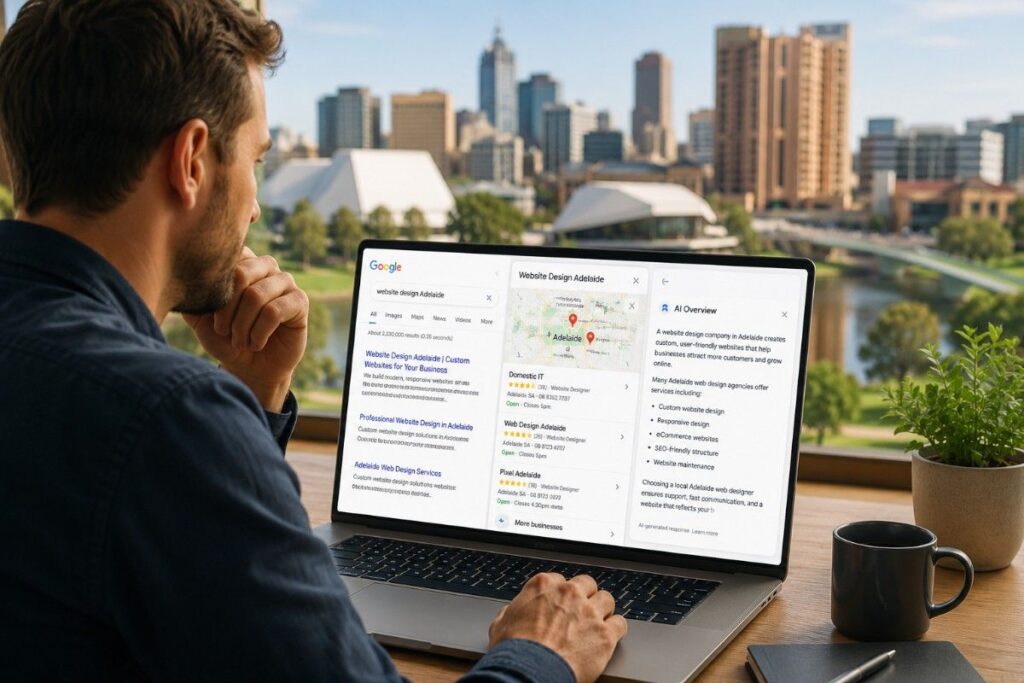
Investing in AI search optimisation Adelaide strategies can help your business become easier to discover when customers search through Google, Google Maps, AI Overviews, AI Mode and other answer-based search experiences. However, success does not come from adding a special AI file or repeating keywords across hundreds of pages. It comes from making your business information accurate, creating useful content, strengthening your online reputation and ensuring search engines can properly access and understand your website.
Google’s current guidance explains that traditional SEO fundamentals remain relevant to generative AI search. Pages still need to be crawlable, indexable, technically accessible and useful to real people. Google also states that businesses do not need special AI markup, special content formats or an llms.txt file to appear in its AI search features.
For an Adelaide business, this means your strategy should connect local SEO, website content, Google Business Profile optimisation, structured data and reputation management. Here are five practical areas to focus on.
Why Google and AI Search Visibility Now Work Together
Traditional Google results usually present a list of web pages, local map listings, products, images or videos. AI-assisted search may combine information from several sources to produce a direct response with supporting links.
Google says AI Overviews and AI Mode can use multiple related searches to explore subtopics and identify supporting pages. The links shown may therefore come from a wider range of useful sources than the websites ranking for one exact keyword.
This creates an opportunity for Adelaide businesses that publish specific, experience-based information. A general page saying that you provide good service may be less useful than a detailed page explaining your process, service areas, pricing factors, common customer problems and actual project outcomes.
Your goal should not be to trick an AI system into mentioning your company. Your goal is to make your business a reliable and clearly identifiable source that search engines can confidently connect with relevant customer questions.
1. Optimize Your Google Business Profile (GBP)
A well-managed Google Business Profile is one of the most important foundations of local visibility. It provides Google with information about what your business does, where it operates, when it is available and how customers can contact it.
Google says complete and accurate business information is more likely to appear for relevant local searches. Local results are mainly influenced by relevance, distance and prominence.
For service businesses targeting Adelaide and surrounding suburbs, your Google Business Profile should support the information displayed on your website. Customers should see the same business name, phone number, service description and operating details in both places.
Primary Category
Your primary category should describe the main service your business is known for. It should not be selected simply because a category appears to have greater search volume.
For example, a company primarily offering web design should choose the closest available web design category rather than using a broader technology category that does not accurately represent the business.
Google recommends choosing a specific primary category that represents the core business. It also advises businesses to use the fewest number of categories needed to describe their overall operations.
Additional categories can be used for genuine secondary services, but adding unrelated categories may weaken the relevance of the profile.
Review your categories whenever your main services change. Your website’s homepage and primary service pages should also reinforce the same core offering.
A natural internal link can be added here:
Learn more about our website design services in Adelaide.
Consistent NAP
NAP stands for name, address and phone number. These details should be presented consistently across your website, Google Business Profile, social media profiles and trusted business directories.
Small formatting differences are not always a serious problem, but customers and search engines should be able to recognise that every listing refers to the same organisation.
Use the same official business name rather than creating keyword-heavy versions for different platforms. For example, do not use one business name on your website and a longer, keyword-stuffed name on Google Maps.
If your company operates as a service-area business and customers do not visit your location, configure the profile according to Google’s service-area guidelines rather than displaying an unsuitable address.
Your website should also have a clearly accessible contact page containing your correct phone number, email address, operating area and business information.
Suggested internal link:
View the areas covered by our Adelaide website design team.
Profile Completeness
Complete every relevant part of the profile, including:
- Business description
- Opening hours
- Special opening hours
- Phone number
- Website address
- Service areas
- Services
- Appointment or enquiry links
- Accessibility information
- Business photos
- Logo and cover image
Upload genuine images that show your team, work, office, completed projects or service process. Avoid relying entirely on generic stock photography.
Google specifically recommends keeping hours current, adding photos and videos, verifying the profile and responding to reviews.
For Domestic IT, the profile could include images of completed Adelaide website projects, team members working on websites, responsive design previews and examples of client industries.
2. Build Web-Wide “Prominence” and Citations
A business becomes easier to understand when its identity is consistently represented across the web.
Google describes prominence as how well-known a business is. It may consider information such as websites linking to the business and the number and quality of customer reviews.
However, prominence should be developed through genuine business activity. Google’s current AI optimisation guidance warns that seeking artificial or inauthentic mentions is not a useful long-term strategy.
Local Directories
Create or update listings on reputable directories that are relevant to Australian or Adelaide businesses.
Potential sources may include:
- Australian business directories
- Adelaide business associations
- Local chambers of commerce
- Industry-specific directories
- Professional membership websites
- Supplier or partner directories
- Trusted community directories
Quality is more important than quantity. One accurate profile on a respected industry directory is more valuable for customers than dozens of incomplete listings on low-quality websites.
Each listing should include your correct business information, a concise description and a link to the most relevant page on your website.
Avoid using the exact same description everywhere. Adapt it to the directory while keeping your brand, location and services consistent.
Earn Mentions
A mention occurs when another website, publication, organisation or content creator discusses your business.
Useful mentions can come from:
- Client case studies
- Local event sponsorships
- Community partnerships
- Industry interviews
- Expert commentary
- Supplier pages
- Business awards
- Professional associations
- Local news coverage
- Guest educational content
For example, Domestic IT could publish a case study explaining how a redesigned website improved enquiries for an Adelaide service business. The client may then reference the project from its own website or social channels.
Original research can also attract citations. You could analyse a sample of local business websites and publish a report such as “Common Website Problems Affecting Adelaide Small Businesses.”
Google recommends creating original, expert-led material that adds information beyond what is already widely available.
Suggested internal link:
See how we approach website redesign projects in Adelaide.
Leverage Social Channels
Social media should support your broader online presence rather than operate separately from your website.
Share:
- New blog articles
- Website launches
- Client success stories
- Business updates
- Team expertise
- Short educational videos
- Frequently asked questions
- Before-and-after website examples
- Community involvement
- Customer feedback
Keep your name, branding, website address and service description consistent across LinkedIn, Facebook, Instagram and other channels you actively use.
Social posting does not guarantee higher Google rankings. Its practical value comes from distributing content, building recognition, attracting relevant website visits and increasing the chance that genuine customers, partners or publications will discover your work.
Focus on two or three channels that your customers actually use rather than creating inactive profiles on every available platform.
3. Implement Structured Data (Schema Markup)
Structured data is code that describes the meaning of website content in a standardised format.
Google can use structured data to understand information about a page, organisation, article or local business. Correct markup may also make a page eligible for certain enhanced search appearances, although Google does not guarantee that a rich result will appear.
JSON-LD is Google’s recommended structured data format. The markup should accurately match information that visitors can see on the page.
Core Schema
Depending on the website and page type, relevant schema may include:
- Organization
- Local Business
- WebSite
- Web page
- Service
- Article
- Breadcrumb List
- Person
- VideoObject
A local Adelaide business can use LocalBusiness markup to describe details such as its business name, location, opening hours and contact information. Google’s documentation confirms that Local Business structured data can help it understand business information.
Do not add every possible schema type to every page. Select the most accurate type for the visible content.
For example:
- Use Organization or an appropriate local business subtype on the main business pages.
- Use Service on genuine service pages.
- Use Article on blog posts.
- Use BreadcrumbList where breadcrumb navigation is visible.
- Use Person for genuine author or team profile pages.
Validate the implementation using Google’s Rich Results Test and the Schema.org validator. Structured data must remain accessible to search crawlers and should not contain hidden, misleading or outdated information.
Suggested internal link:
Our SEO-friendly website design service includes technical structure planning.
FAQ Schema
FAQ content can still be valuable because it answers customer questions in a clear and organised way. However, businesses should not add FAQ Schema expecting a special Google FAQ result.
Google stopped displaying FAQ rich results on May 7, 2026, and removed its FAQ rich-result documentation in June 2026.
This means the main value of an FAQ section is now the usefulness of the visible content itself.
Create FAQs that address genuine customer concerns, such as:
- How much does a website cost in Adelaide?
- How long does a website project take?
- Can an existing website be redesigned?
- Will the website work on mobile devices?
- Is SEO included in website development?
- Can the business update the website later?
Keep each answer accurate, direct and specific to your service. Do not add dozens of repetitive questions simply to target keyword variations.
Schema.org may continue to define FAQ-related vocabulary, but businesses should not treat it as a Google ranking shortcut or a guaranteed search feature.
4. Optimize for AI Extractability Through Answer-First Formatting
Content should be easy for people to scan, understand and use. Clear formatting can also make it easier for search systems to identify which passage addresses a particular question.
This does not mean that Google requires businesses to divide every page into tiny content blocks. Google specifically states that there is no requirement to “chunk” content or rewrite everything exclusively for AI systems.
Answer-first formatting is valuable because it improves clarity for the reader.
Direct Answers
Begin important sections with a direct response before adding supporting details.
For example:
How much does website design cost in Adelaide?
Website design costs vary depending on the number of pages, required functionality, content, ecommerce features, integrations and level of customisation.
The following paragraphs can then explain each pricing factor.
This structure helps busy readers understand the main point quickly. It may also create a clear passage that search systems can associate with a specific question.
Avoid introductions that take several paragraphs to answer a simple query.
Clear Headings
Use descriptive headings that reflect the questions and decisions customers actually have.
A weak heading would be:
“Our Solutions”
A more useful heading would be:
“Website Design Services for Adelaide Small Businesses”
Your page should contain one clear H1 followed by logically arranged H2 and H3 headings.
Do not place headings in an order that skips levels without a reason. Headings should help visitors move through the content and understand how each section relates to the main subject.
Google recommends organising content with clear paragraphs, sections and headings for human readers.
Use Lists and Tables
Lists are useful for:
- Steps
- Features
- Requirements
- Benefits
- Common mistakes
- Service inclusions
- Preparation checklists
Tables are useful for comparing:
- Service packages
- Website platforms
- Project options
- Features
- Pricing factors
- Redesign and new-build projects
Do not turn every paragraph into a list. Use the format that communicates the information most clearly.
A comparison table can be especially useful for decision-based searches such as “WordPress vs Wix” or “website redesign vs new website.”
5. Drive High-Quality Reviews
Reviews can influence customer trust and local visibility. Google states that more reviews and positive ratings can help local ranking, while helpful responses can make a business stand out.
The goal should be to build a reliable process for requesting honest feedback from genuine customers.
Never purchase reviews, create fake accounts, offer rewards in exchange for positive ratings or ask people who have not used your service to leave feedback.
Review Velocity
Review velocity refers to how frequently a business receives new reviews.
Google does not publish a fixed review velocity formula or guarantee that receiving a certain number of reviews each month will improve rankings.
From a reputation perspective, however, a steady flow of genuine reviews can show potential customers that the business remains active. Ten recent reviews spread across a year may appear more relevant than a large collection received during one short campaign several years ago.
Build review requests into your normal customer process:
- Complete the service.
- Confirm that the customer is satisfied.
- Send a simple review request.
- Include the direct Google review link.
- Follow up once when appropriate.
- Do not pressure the customer.
Google allows businesses to share a review link or QR code when asking customers for feedback.
Keyword-Rich Feedback
Do not tell customers exactly what to write or demand that they include specific keywords.
Instead, ask open questions that encourage useful and detailed feedback:
- What service did we provide?
- What problem were you trying to solve?
- What part of the process did you find most helpful?
- What result did the project achieve?
- Would you recommend our business to others?
A customer may naturally mention the service and location in the response, such as:
“Domestic IT redesigned our Adelaide business website and made it much easier for customers to request a quote.”
This type of detail helps future customers understand the reviewer’s experience. It is more credible than a generic comment and avoids manipulating the wording of the review.
Engage
Reply to positive, neutral and negative reviews professionally.
A useful response should:
- Thank the customer
- Refer naturally to the service provided
- Address any concern raised
- Avoid sharing private information
- Remain polite
- Keep the response focused
- Invite offline discussion when necessary
Google says public replies demonstrate that the business values customer feedback. It also recommends keeping responses professional, relevant and concise.
Avoid using the same copied response for every customer. A personalised reply shows that someone has actually read the feedback.
Create a Connected Google and AI Search Strategy
The most effective AI search optimisation Adelaide strategy connects all of these areas.
Your Google Business Profile introduces your business to local customers. Citations and genuine mentions strengthen your wider online presence. Structured data clarifies important website information. Answer-first content makes your expertise easier to understand. Reviews provide evidence of real customer experiences.
These activities should support a technically sound website with:
- Mobile-friendly design
- Fast-loading pages
- Secure HTTPS
- Clear navigation
- Indexable content
- Strong internal linking
- Unique service pages
- Useful Adelaide-focused content
- Accurate contact information
- Original images and case studies
Google’s guidance makes it clear that appearing in AI search still depends on strong SEO foundations, valuable content and a technically accessible website. There is no guaranteed placement, even when all recommendations are followed.
Domestic IT helps Adelaide businesses create professional, search-friendly websites designed around customer needs. Whether you need a new website, a redesign or stronger local visibility, the right website structure can help your business compete in both traditional and AI-assisted search.
Contact Domestic IT to discuss your website and online visibility goals.
Frequently Asked Questions
What is AI search optimisation Adelaide?
AI search optimisation Adelaide is the process of improving a business’s online presence so it can appear more clearly in Google search results, Google Maps, AI Overviews and other AI-powered search platforms. It combines local SEO, helpful website content, Google Business Profile optimisation, structured data, citations and customer reviews.
How can my Adelaide business appear in Google AI search results?
Your business can improve its chances of appearing in AI-generated search results by publishing accurate and useful content, answering customer questions directly, maintaining a complete Google Business Profile and earning trusted mentions across the web. Your website should also be mobile-friendly, secure, fast and easy for search engines to crawl.
Is AI search optimisation different from traditional SEO?
AI search optimisation and traditional SEO are closely connected. Traditional SEO focuses on website rankings, keywords, links and technical performance, while AI search optimisation also focuses on making information clear, trustworthy and easy for AI systems to extract. Strong SEO foundations are still necessary for visibility in AI search.
Does Google Business Profile help with AI search visibility?
Yes. A complete and accurate Google Business Profile helps Google understand your business name, services, location, opening hours and customer reputation. For local Adelaide searches, an optimised profile can support visibility across Google Search, Google Maps and AI-assisted local results.
What type of content performs well in AI search results?
Content that provides clear, direct and well-structured answers is more useful for AI search. Use descriptive headings, short answer-first paragraphs, FAQs, lists, tables, examples and original business insights. Each page should focus on a specific customer need rather than covering too many unrelated topics.
How important are customer reviews for local search visibility?
Customer reviews are important for trust, local prominence and purchasing decisions. A steady flow of genuine reviews can show that your business is active and reliable. Encourage customers to describe the service they received naturally, and respond professionally to both positive and negative feedback.
How long does AI search optimisation take to produce results?
There is no fixed timeframe because results depend on your website condition, competition, existing authority, content quality and local presence. Some improvements, such as updating a Google Business Profile, may help quickly, while stronger organic and AI search visibility usually develops gradually through consistent optimisation, content publishing and reputation building.
Pingback: Small Business Website Design Adelaide: Key Features
Pingback: How a Website Helps Adelaide Businesses Get Customers