
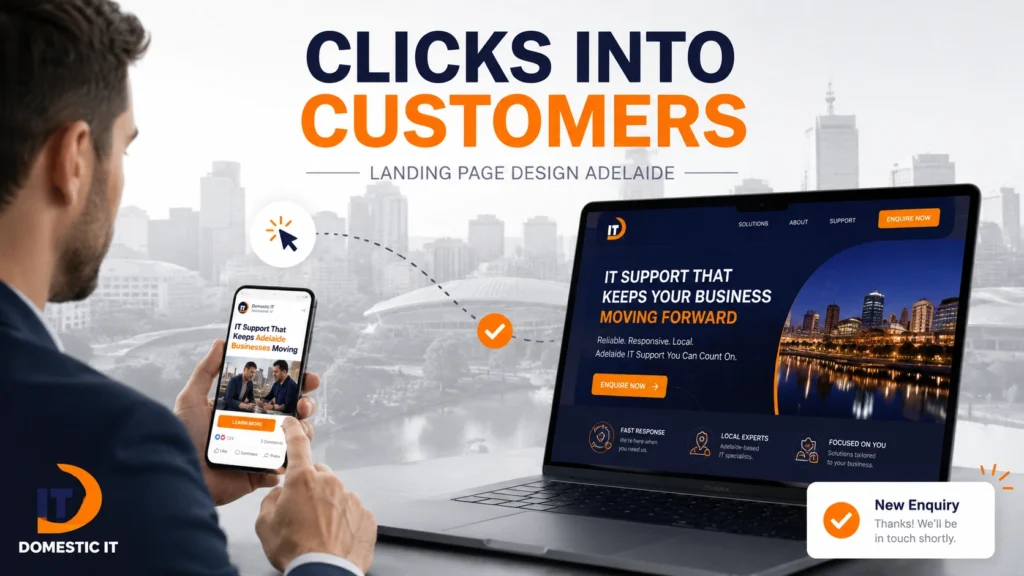
Effective landing page design in Adelaide is not about creating a shorter version of your homepage. It is about giving one specific audience a clear reason to take one specific action. When someone arrives from Google Ads, Facebook, Instagram, LinkedIn or an email campaign, the page should continue the same promise they saw before clicking. A focused message, strong proof and simple conversion path can turn paid traffic into calls, bookings, quote requests or sales.
Many Adelaide landing-page providers discuss attractive design, campaign alignment and conversion tracking. Those elements matter, but a high-performing page also needs to reflect the customer’s stage of awareness, remove hesitation and collect enough data to improve future campaigns.
Core Elements of High-Converting Landing Page Design
A landing page should reduce the amount of thinking required from the visitor. Every section should either explain the offer, build confidence or move the person towards the main action.
Message Match
Message match means keeping the advertisement, keyword and landing-page content aligned.
Suppose an Adelaide homeowner clicks an advertisement offering a free exterior painting quote. The landing page should immediately mention exterior painting and the free quote. Sending that visitor to a general homepage covering interior painting, commercial projects and several unrelated services creates uncertainty.
The page headline, supporting copy and call to action should confirm:
- The visitor is in the right place
- The advertised service is available
- The promised benefit still applies
- The next step is clear
Google advises advertisers to keep advertisements closely related to the keywords and customer intent behind them. Google also considers the usefulness, relevance and usability of a landing page when evaluating the landing-page experience.
Message match also applies to visual design. The colours, offer and imagery used in the advertisement should feel connected to the landing page. The visitor should not feel as though they have been sent to a different company.
The Hero Section
The hero section is the first area visitors see. It has only a few seconds to establish relevance and direction.
A strong hero section normally includes:
- A specific headline
- A short explanation of the offer
- One primary call to action
- A relevant image or visual
- A trust signal
- Essential location context
For example:
Professional Landing Pages Built for Adelaide Campaigns
Convert more Google and social-media visitors with a fast, focused page designed around one offer.
Request a Free Consultation
Avoid opening with vague phrases such as “Welcome to Our Website” or “Innovative Digital Solutions.” These statements do not explain what the visitor will receive.
The first screen does not need to contain every detail. Its job is to make the offer understandable and encourage the visitor to continue or take action.
Domestic IT’s landing page design service focuses on responsive campaign pages built to generate enquiries and support digital advertising. The service page should remain the main commercial destination for people ready to request a project.
Single Focus
A homepage may need to introduce several services and help different types of visitors. A campaign landing page should be narrower.
Select one primary conversion goal, such as:
- Requesting a quote
- Booking a consultation
- Calling the business
- Registering for an event
- Downloading a guide
- Purchasing one product
- Starting a free trial
You can repeat the same call to action in different sections, but avoid presenting several competing actions with equal visual importance.
For example, a page should not ask visitors to request a quote, subscribe to a newsletter, read ten blog articles, follow four social profiles and browse every service at the same time.
Secondary links may still be necessary for privacy information, terms or supporting evidence. However, they should not distract visitors from the main campaign goal.
Trust and Proof
Visitors often arrive on a landing page without knowing much about the business. They need reasons to believe the offer and feel comfortable sharing their information.
Useful trust elements include:
- Genuine Google reviews
- Customer testimonials
- Project photographs
- Case studies
- Client logos
- Licence or accreditation details
- Team photographs
- Years of relevant experience
- Clear contact information
- Privacy reassurance near forms
Place proof beside the claim it supports.
For example, if the page says your team delivers responsive websites, show a real mobile and desktop example nearby. If you mention strong customer service, place a relevant testimonial close to that section.
Do not add decorative badges that visitors cannot verify. Real evidence is stronger than generic labels such as “number one,” “trusted” or “award-winning.”
Domestic IT’s website design portfolio can be linked from a landing page when visitors need to review completed work before making an enquiry.
Speed and Mobile Layout
A significant amount of campaign traffic may arrive on mobile devices. The page should therefore be designed around smaller screens instead of treating mobile layout as a final adjustment.
Check that mobile visitors can:
- Read the headline without zooming
- Understand the offer immediately
- Tap buttons easily
- Complete the form comfortably
- Call the business with one tap
- View reviews and proof
- Load the page without unnecessary delays
Large video backgrounds, oversized images, pop-ups and multiple tracking scripts can slow the experience. Keep the design visually strong without loading elements that do not contribute to the conversion.
You can evaluate individual page performance using Google PageSpeed Insights. Use the results to identify image, script and layout issues, but also test the page manually on real mobile devices.
Complex campaign requirements may need custom website development for calculators, booking systems, CRM connections or tailored lead-routing workflows.
Do I Really Need Landing Pages for My Campaigns?
A dedicated landing page is not necessary for every marketing activity. It becomes particularly valuable when the advertisement promotes a specific service, audience, location or offer.
When Your Homepage Is Too General
Your homepage may describe the entire business. That can be useful for branded searches and general visitors, but it may not provide the focused experience required by a paid campaign.
Consider a business offering:
- Website design
- Ecommerce development
- SEO
- Graphic design
- Social-media marketing
- Website maintenance
A person who clicks an advertisement for ecommerce development should not have to search through all those services. A dedicated page can focus on ecommerce needs, store features, relevant examples and one enquiry form.
When You Target Different Audiences
Different customers may need different messages even when the service is similar.
For example, a web-design campaign could target:
- Adelaide tradies
- NDIS providers
- Restaurants
- Professional consultants
- Ecommerce retailers
Each group has different goals, concerns and examples of success. Sending every audience to the same generic page limits the relevance of the campaign.
You do not necessarily need a completely different design for each audience. A structured template can be adapted with different headlines, proof, benefits and forms.
When You Need Better Campaign Measurement
Dedicated landing pages make it easier to understand what happens after the click.
You can track:
- Form submissions
- Phone-button clicks
- Bookings
- Purchases
- Download completions
- Cost per lead
- Conversion rate
- Traffic source
- Device performance
Without conversion tracking, a campaign may appear successful because it generates clicks, even when those clicks produce few genuine enquiries.
The form confirmation or thank-you page should also be tracked. This provides more reliable information than measuring button clicks alone.
When You Want to Test an Offer
Landing pages allow controlled testing of important elements.
Possible tests include:
- Headline wording
- Hero image
- Call-to-action text
- Form length
- Social proof
- Offer positioning
- Page order
- Button placement
Change one meaningful element at a time when possible. If you change the headline, image, offer and form simultaneously, you may know that performance changed without knowing why.
A landing page should be treated as a campaign asset that can improve over time, not a page that is published once and forgotten.
A Powerful Landing Page Is the Difference Between a Click and a Customer
The advertisement earns attention. The landing page must turn that attention into confidence and action.
Reduce Friction at Every Step
Friction is anything that makes the next step feel difficult, uncertain or risky.
Common examples include:
- Long forms
- Unclear button labels
- Hidden contact details
- Slow pages
- Complicated navigation
- Unexplained pricing
- Weak mobile layout
- Requests for unnecessary personal information
A quote form should ask only for information needed to begin the conversation. Additional details can be collected later.
Instead of a generic “Submit” button, use wording that explains the result:
- Request My Quote
- Book My Consultation
- Get My Free Audit
- Check Availability
- Start My Project
Answer Objections Before They Stop the Enquiry
Visitors may hesitate because they are unsure about price, timeframe, suitability or what happens next.
A landing page can address these concerns through concise sections such as:
- Who the service is for
- What is included
- How the process works
- Expected turnaround
- Frequently asked questions
- What happens after form submission
Do not avoid every difficult question. Clear expectations can improve lead quality by helping unsuitable visitors decide before contacting the business.
For broader website structure and conversion planning, visitors can also review Domestic IT’s website design services in Adelaide.
Give Visitors Enough Proof to Decide
Too little information creates uncertainty. Too much information can bury the offer.
The right page length depends on the decision.
A simple event registration page may require only a few sections. A landing page for a high-value commercial service may need detailed benefits, case studies, process information, FAQs and several trust signals.
The page should be long enough to answer the visitor’s main questions, but not filled with repeated claims.
Domestic IT’s existing guide to landing page design best practices provides a general checklist covering headlines, calls to action, mobile optimisation and trust elements. This new article is intentionally focused on the campaign journey, decision-making process and conversion strategy.
How to Plan, Launch and Improve Your Landing Page
A successful landing page begins before the design stage. The offer, audience, traffic source and measurement plan should be clear first.
Define the Campaign Before Designing
Write down:
- Who the page is for
- Where the traffic will come from
- What problem the visitor wants solved
- What the advertisement promises
- What action the visitor should take
- How the conversion will be measured
This prevents the design from becoming a collection of attractive but disconnected sections.
Connect the Page to Your Sales Process
The enquiry process does not finish when the visitor submits a form.
Decide:
- Who receives the lead
- How quickly the lead will be contacted
- Which details should enter the CRM
- Whether an automated confirmation is required
- What the thank-you page should say
- How spam or low-quality submissions will be handled
A strong landing page cannot compensate for slow follow-up. The page and sales process should work as one system.
Improve the Page Using Real Data
After launch, review performance by traffic source, device and campaign.
Look for patterns such as:
- Strong clicks but few form submissions
- High mobile exits
- Calls but no tracked forms
- Many form starts but few completions
- One campaign producing higher-quality leads
- Visitors leaving before reaching important proof
Use these findings to form a specific testing idea. Do not redesign the entire page based on a small amount of data or personal preference.
Landing Pages FAQs
What is the difference between a landing page and a homepage?
A homepage introduces the wider business and may lead visitors towards several services. A landing page is designed for one audience, campaign or offer and normally focuses on one conversion action.
Can a landing page be used for Google Ads?
Yes. A dedicated page can align the advertisement, keyword and offer more closely. Google assesses landing-page relevance, usefulness and usability as part of the landing-page experience. (Google Support)
How many calls to action should a landing page have?
A landing page should usually have one primary conversion goal. The same call to action can appear several times, but competing actions should be limited.
How long should a landing page be?
The page should be long enough to explain the offer, answer important objections and establish trust. Simple offers may need a short page, while expensive or complex services often need more detail.
Should a landing page include the main website menu?
Not always. Removing or simplifying the main menu can reduce distractions during paid campaigns. Essential links such as privacy policies and contact information should still remain accessible.
What should a landing-page form ask?
Ask only for details needed to qualify the lead and provide a useful response. Name, contact information, required service and a short project description may be enough for an initial enquiry.
How do I know whether my landing page is working?
Measure completed forms, calls, bookings or sales rather than relying only on page visits. Compare conversion rate, lead quality and cost per conversion across campaigns and devices.
Turn More Adelaide Campaign Clicks Into Customers
A successful landing page connects the promise in your advertisement with a focused, credible and easy-to-use experience. It helps visitors understand the offer, trust the business and complete the next step without unnecessary distractions.
Domestic IT designs responsive landing pages for Adelaide businesses running Google Ads, social-media campaigns, lead-generation offers and product promotions.
To discuss your campaign,contact Domestic IT or call us 0480 456 328